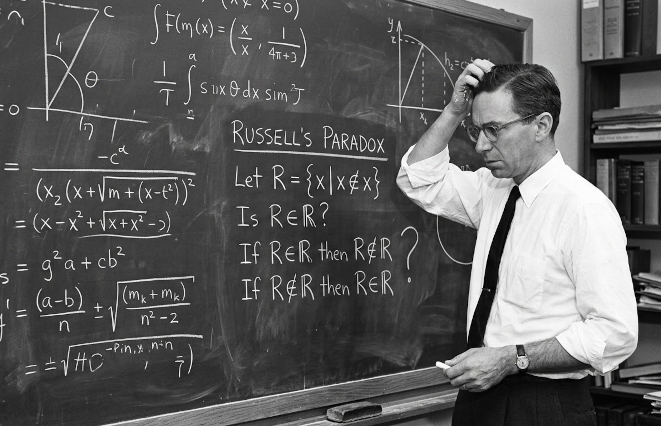
The paradox in the pause
Imagine you are young Nephi. Your father has just uprooted your family and led you all into the wilderness. Unlike your brothers, you turned to the Lord and received confirmation of your father’s calling. Then the Lord revealed to you personally and directly that you and your brothers are headed for the land of promise. Immediately receiving this revelation, your father tells you “the Lord hath commanded me that thou and thy brethren shall return to Jerusalem” (1 Nephi 3:2). The verse ends there; I don’t know if Lehi paused at this point in his discussion with Nephi, but I was prompted recently to pause there in my reading. If you were Nephi, what might you have thought and felt during that pause?
“We’re going back? But God just told me we’re going to a new land! How can God contradict Himself?”
Any paradox Nephi might have faced in that moment would have been fleeting as his father clarified the return would be temporary. But as I pondered on Nephi’s “paradox in the pause,” I remembered many other cases in scripture where Saints have had to face much tougher, much longer divine paradoxes— some of which we still face today. And it’s what we do with those paradoxes that demonstrates our faith.
A few scriptural examples
The Lord told Abraham he would be a father of many nations, with descendants as numberless as the sands or the stars. Yet year after year, decade after decade, Sarah remained barren. The Lord had promised Abraham seed, yet there was no seed. So Abraham and Sarah tried to resolve that paradox using Hagar. But when Ishmael came, the Lord rejected him as the promised seed. After many years, when Sarah was in her nineties, the Lord finally resolved the paradox— He opened her womb and gave them Isaac, confirming that Isaac would be the channel through which the blessings of posterity would come.
Fast forward a few years and the Lord commanded Abraham to offer that promised son as a sacrifice on Mount Moriah. Another paradox: “Your lineage would continue through Isaac. Also you must kill Isaac.” At the very last second, as Abraham lifted his knife, the Lord resolved the paradox— Isaac was truly offered on the altar but the Lord did not require him, and provided a lamb in the thicket.
Two generations later, Jacob watched 11 of his 12 sons disqualify themselves for the birthright. Prophecy indicated the birthright would go to Joseph, and all his family would kneel at his feet. But Joseph’s brothers returned to their father with the heart-wrenching news and the bloody cloak. Joseph, the future patriarch, was dead. Jacob lived in faithful anguish for decades. The Lord resolved the paradox later, showing His miraculous power in preserving Joseph in Egypt.
The original disciples of the mortal Christ received personal witnesses from the Holy Ghost that Jesus was the Messiah, even the Begotten Son of God. Yet after three short years with Him, they were horrified to watch the impossible happen— the corpse of the God of Heaven hung limp and lifeless on a cross! The paradox tormented them for three days until the Lord resolved the paradox by resurrecting on the third day.
The Lord repeatedly told those same first century followers that He would return in glory “quickly… in this generation.” Yet here we are two thousand years later, and the Lord has not yet returned. The Lord has resolved this paradox by explaining to us His timing— that one day for him is a thousand years for us and John the Revelator still lives, etc.
The early Saints of this dispensation
But here’s my favorite example of a divine paradox. The Bible teaches (and the Book of Mormon and Doctrine & Covenants makes inescapably clear) that baptism by legitimate priesthood authority is a required ordinance for salvation. What of those that lived and died without even hearing that such an authority exists? The answer you’d hear from a Latter-day Saint in 1831 would likely sound very similar to hard-line Protestants today: “Sorry, dem’s da rules. Narrow is the path to salvation and few there be that find it.”
This stance was softened a little in 1832 when Joseph received D&C 76 and learned that honorable, unbaptized people would inherit a lesser kingdom of glory. But still, 99.999% of God’s children would be excluded from the Celestial Kingdom merely because they were born in the wrong place and time!
Four years later, as a kind of “sequel” to D&C 76, Joseph saw the vision of heaven we now know as D&C 137. To his surprise, Joseph saw his deceased and unbaptized brother Alvin in the Celestial Kingdom. As he “marveled,” the Lord confirmed that “all who have died without a knowledge of this gospel, who would have received it if they had been permitted to tarry, shall be heirs of the celestial kingdom of God… For I, the Lord, will judge all men according to their works, according to the desire of their hearts.”
Notice the Lord didn’t yet reveal how that was possible. So the Saints of 1832 believed two contradictory positions at the same time: that baptism was absolutely essential to enter the Celestial Kingdom— no exceptions. Also the righteous will inherit the Celestial Kingdom even if they died without baptism. It was a complete doctrinal paradox they didn’t know how to resolve. But they stuck with it until the Lord resolved that paradox in 1840 with the revelation on baptisms for the dead.
What will you do with your next paradox?
The pattern is clear: God doesn’t dump knowledge on us all at once. He pauses and allows us to live in a state of contradiction to test our faith. Many of the past paradoxes have been satisfied, and God has promised that in some future day all the answers will be given. Someday, we’ll look back on all our mortal pauses as we now view the fleeting 1-verse pause in Lehi’s words to Nephi. The question isn’t whether we’ll get answers about sealings and dinosaurs and papyri— it’s what we’ll do until they come.
And that’s where we probably should be a little nervous.
Suppose this year some piece of history comes to light that contradicts the historical or doctrinal claims of the Church— not some CES Letter garbage— I mean an absolute contradiction against the Church no apologist can explain away. What would you do? What do you think would happen to Church membership?
We don’t have to stretch our imaginations too far to find a real-life analog to this. Mark Hofmann had a reputation for discovering authentic early Church documents that withstood the forensic analysis of the time. When he produced the infamous “salamander letter,” it appeared in every respect to be a bona fide article. So, modern Church members were suddenly faced with a horrible paradox: a seemingly legitimate historical document with bizarre claims that contradicts what Joseph taught in his official history. Sadly, some chose not to wait for the Lord to resolve the paradox, and they left the Church. And when the document was proved a forgery, very few returned.
What can we do to faithfully navigate such paradoxes and contradictions? I have a few suggestions.
“It’s not you, it’s me.”
We’ve all sat through Sunday School comments that make us squirm in our seats. If the lesson topic is following the prophet, Bro. Wilkinson will raise his hand and complain that Pres. Nelson pushed the COVID vax, Sis. McDonough will say that polygamy is adultery and D&C 132 isn’t a true revelation, and the visiting college student will testify that the Family Proclamation is just a legally motivated, changeable policy like the priesthood ban.
You might ask “isn’t it good to dig into Church teachings and wrestle with the scriptures?” I’d respond, “Yes, but it’s not good to take a dig at Church teachings or wrest the scriptures.”
Socially, there is a big emphasis on being raw, vulnerable, and authentic. But “vulnerability” is not what I sense when I hear people bear such “anti-testimonies” expressing not just anxiety about but active disbelief in sacred Church teachings.
So the first line of defense when we face a paradox is attitude. If I am concerned with a matter of Church teachings or history, that’s a me problem— not a problem with God, His word, or His Church. Our “wrestle” is not against D&C 132 or the Family Proclamation— it’s with our natural man that “sees through a glass darkly” in a fallen world. Keep that front of mind, and you’ll keep your heart receptive for the answer when it comes.
For example, I recently heard someone state that “polygamy is always just adultery” (a sentiment that’s growing increasingly prevalent). Contrast that “anti-testimony” with a touching testimony I heard recently:
I don’t understand polygamy. It doesn’t feel right to me. It feels icky, and I think it’s supposed to feel icky. I don’t have a testimony of polygamy. And God isn’t asking me to have a testimony of polygamy specifically. But I do have a testimony that the Book of Mormon is true. I do have a testimony that Joseph Smith is a Prophet, and that the Lord Jesus Christ leads this Church. So— by extension if by nothing else— I believe that somehow, in some way I may never understand in this mortal life, polygamy was an inspired practice.
That’s raw. That’s vulnerable. That’s authentic. But that’s also edifying and faith-building.
Seek answers (plural!)
The way critics hoot and holler, you’d think every controversy was an “uncontested slam dunk” against our faith— as if our entire theology hinges on whether archaeologists can find horse bones dating before Columbus. Some struggling Saints make the same mistake. “If I can’t find the answer to this question to my satisfaction, then the Church must not be true.” Pres. Nelson branded those who buy the shallow Reddit anti-Mormonism the label of “lazy learners.” I’m also worried about “lazy ignorers—” members who avoid controversial topics altogether because they’re worried actual knowledge will threaten their faith. Both groups make the same mistake of assuming faith is impossible without a single satisfactory answer.
But we are richly blessed today with a wealth of resources— published by the Church and Church-supportive institutions— to address every controversy or paradox you can imagine. The problem today is not that we have no answer— it’s almost that we have too many answers! Criticisms of the Book of Abraham as a funerary text sound like they solidly destroy its legitimacy as scripture… until you read the Gospel Topics essay and start learning what faithful scholars have offered as explanations for its origins. A little bit of actual research from BYU, Scripture Central, the Interpreter Foundation, etc and you’ll find 5 completely plausible explanations for how the papyri fragments could be funerary texts and yet the Book of Abraham could still be scripture.
Maybe the Lord will reveal that the translated portion was burned in the Chicago fire. Or maybe He’ll tell us it was the “catalyst” theory. Or something else we haven’t even thought of. Point is it’s disingenuous to require “the answer” to exercise faith. Simply knowing there is space for the answer and this isn’t a “sudden death” proposition gives us the intellectual space for faith.
Check your Latter-day Saint privilege
If you’re reading this article, you are likely incredibly— almost obscenely— wealthy. Oh, you don’t feel particularly wealthy? Remember that kings and emperors until just a few decades ago could only dream of the luxuries even the poor today enjoy in first world countries. But we forget how richly blessed we are because we were “privileged” to be born in this century. I worry that too often, Latter-day Saints forget the rich theological “privilege” they enjoy. We wring our hands and our testimony cracks because we don’t know exactly how sealings are going to work out. So we may be tempted to abandon our faith, not realizing that it’s only because of our faith that we believe in any sort of family relationships in the afterlife at all! We get so hung up on the unanswered questions of our rich theology and the accusations of critics that we forget how much richer it is than any other belief system on earth. We have a much fuller but still incomplete puzzle, and we have no reason to be embarrassed about the paradoxes that come with it.
Wait through the pause
Developing the right attitude, seeking answers, and checking our privilege will help us, but at the end of the day we simply have to wait through the pause. The Lord has promised that all the answers will come in His time. We don’t have to know how or when— we just have to trust that He will resolve the paradoxes in His own way and in His own time. Sometimes that pause lasts a moment, sometimes a lifetime, sometimes longer. But if will wait for Him in faith, we will never be disappointed by the answers He longs to give us.